
Catering Delivery in Toronto: An Event-Day Handoff Checklist That Works
A practical Toronto catering delivery checklist for venue access, packing counts, arrival windows, food temperature, and proof of handoff.
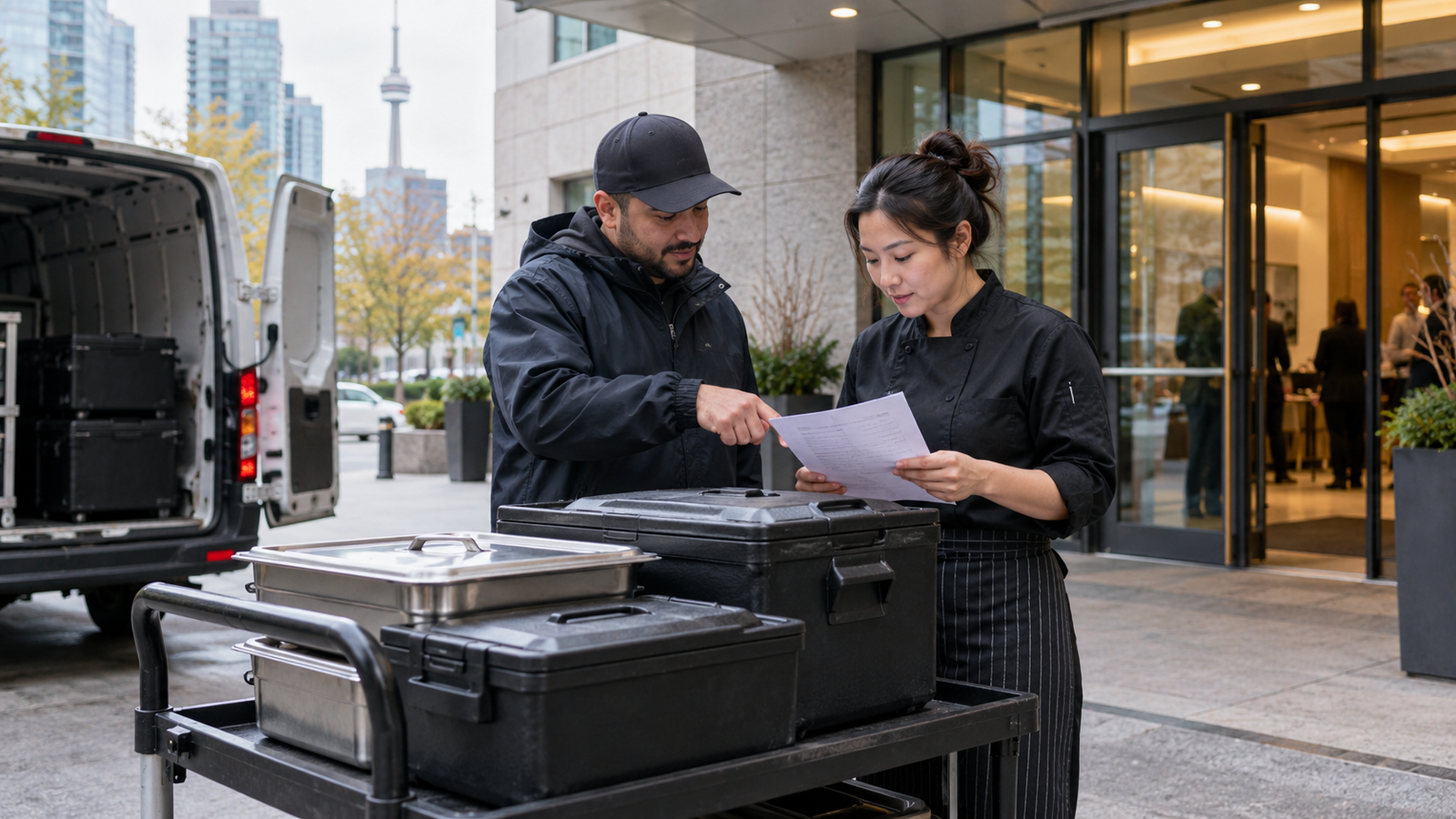
The driver reaches the venue on time. The loading dock is locked. The event contact is upstairs setting tables and cannot answer the phone. The food has arrived, but the handoff has not. This is the kind of delivery failure that a better route sheet can prevent.
For Toronto caterers, restaurants and event planners, “delivered” should mean the right number of items reached the right person while there was still time to set up. The checklist below separates kitchen release, travel and venue receiving so no one assumes another team has handled a critical detail.
Work backwards from service time
If guests arrive at 6 p.m., 6 p.m. is not the delivery deadline. Ask the event lead when the venue will be ready to receive, how long unloading and setup take, and whether there is a restricted access window. Then set the delivery window with margin before service. For a multi-venue day, do this for every location rather than treating the route as one long appointment.
Separate these times on the job sheet: food ready for pickup, courier pickup, venue receiving window and service start. When one changes, the event lead and dispatch both need the update. A tight schedule cannot be rescued by labeling every trip “urgent.”
Prepare a count that both sides can verify
“Eight trays” is not enough if three trays are for one meeting room and five are for another. Number sealed containers by destination or service area, then list the total physical pieces, including stands, cutlery cartons or separate beverages. Keep a copy with the kitchen and another with the person handing off to the courier. At the venue, the receiving contact can check the count before the driver leaves.
- Order identity: client, event name, date and a short reference.
- Piece count: trays, boxes and non-food equipment listed separately.
- Handling: which containers must stay level, stay sealed or be kept apart.
- Contacts: one kitchen release contact and one on-site receiver, both reachable.
- Exceptions: a missing piece, change of entrance or delayed receiver gets recorded and communicated immediately.
Do not leave temperature to chance
The menu determines the transport plan. Potentially hazardous cold or hot food needs appropriate holding conditions, and an ordinary courier booking does not itself provide refrigerated or heated equipment. Toronto Public Health’s special-event food guidance explains transport practices for perishable food. The caterer should decide what equipment and checks are required, then confirm the courier arrangement can accommodate them. If it cannot, use a suitable food-transport option instead.
Avoid asking a driver to judge whether food is safe by appearance. Put temperature and handling responsibilities in the event plan, and give the receiver instructions for immediate storage or service.
Write the venue instructions as if the driver has never been there
A venue name is not an access plan. Include the street entrance actually used for deliveries, dock booking rules, loading limits, parking restrictions, lift access, floor and room. If a security desk requires a company name or pre-registration, arrange it before the courier leaves the kitchen. In downtown Toronto, the correct entrance can be around the block from the guest entrance.
Identify a primary receiver and a backup. When a venue has several events on the same day, “leave it with staff” is too vague. The driver should know whose acknowledgement closes the handoff and what to do if that person cannot be reached.
Event-day handoff checklist
- Confirm the receiving window and service start with the event lead.
- Seal, label and count every piece at kitchen release.
- Confirm food-safety transport requirements and suitable equipment.
- Send dispatch the exact entrance, dock, room and two contact numbers.
- Tell the receiver the expected window and piece count.
- At arrival, reconcile the count and capture the agreed proof of delivery.
- Escalate a missing item or access problem immediately, while a remedy is still possible.
Choose the route that fits the event
A single gala drop-off may call for a direct, time-specific trip. A weekday office-catering programme may suit scheduled stops, provided each location has a clear receiver and enough buffer. If you also deliver celebration desserts, our bakery delivery guide covers packaging for fragile cakes. For weekly production runs, see recurring meal-prep routes.
Sparkle Express can receive handling notes and organize same-day or scheduled local delivery, subject to dispatch confirmation. Describe the menu, packaging, schedule and access details when asking about specialty-food delivery; do not assume a service capability that has not been confirmed for your booking.
Frequently Asked Questions
How early should catering arrive before an event?
Work backwards from the real setup and service schedule. Allow time for unloading, access, count checking and placing food. Confirm the receiving window with the venue and the delivery window with dispatch.
Can catering be left with a concierge or security desk?
Only if the caterer, client and venue have agreed that this is an appropriate handoff for the specific order. Food that requires immediate holding or a count check usually needs a designated receiver.
Who is responsible for safe food temperature in transit?
The food business should determine the required controls and verify that its chosen transport arrangement can maintain them. Confirm equipment and handoff procedures before dispatch; a standard courier vehicle is not automatically temperature-controlled.
What should proof of delivery include?
At minimum, record the arrival or completion time and the agreed receiving point. For higher-value events, confirm whether a recipient name, piece count or photo record is needed and available.
Bottom line: the event team needs a usable handoff, not just a vehicle at the curb. A named receiver, accurate count and clear access instructions turn the last mile into a planned part of service.